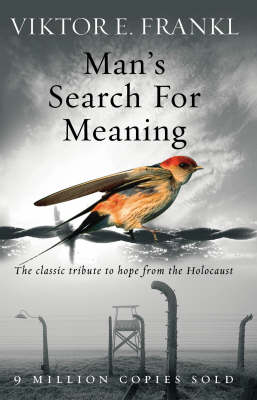
 A classic tribute to hope from a physician who has experienced the Holocaust, – this book became a bestseller – indirectly proving that this subject matters to us all.
The book starts with the depiction of life in the Nazism prisoner camp – how the only thing that mattered was survival – thus explaining the newly-formed hierarchy among prisoners themselves.
It vividly describes the pains of hunger, coldness, physical work and the emotional poverty – as nobody knew how much time would it all last, how would it all end and whether their beloved ones were still alive – somewhere far away.
In the midst of this experience, Dr. Frankl has sketched various snippets on small pieces of paper on what would become the third psychology school of Vienna – logotherapy – and in the later editions of this book, he explained his theory in the book’s second chapter.
Life meaning is unique to every human being – and it dynamically varies, as our life changes too. He identified three manners of finding meaning in life:
1 – by creating values or accomplishing some actions
2 – by contemplating – nature, the truth, beauty, beloved ones
3 – life means suffering and surviving it means finding meaning in suffering
You can read the book at your closest library in English – since I’m currently learning German, I promised myself I would read this masterpiece in the original language too 🙂
Why does life matters? Why do you continue to wake up every morning?
I’m looking forward to your comments!

Ive started this book 🙂
Great – do you like it by far?
Life matters because anything else happens in it. If life ends, then everything else ends, for the given individual. It’s almost tautological.
Now, the interesting thing is, if you could choose what to do in life, what would you do? Moreover, assume that you choose something that you will enjoy and will want to continue to do. Then what is the best to do? And how could you increase the chance of being able to continue to do it?
My answer to the first question used to be: it does not matter! do whatever you happen to really like (surely enough, there’s no shortage of kinds of pleasures and passions possible).
My answer to the second question was, and is: you gotta strive to stay alive.
All quite obvious (to me at least).
But then, the catch is that: to stay alive for longest, you have to have, as the main and master goal – your own longevity; survival; life extension. Any other goal is going to be detrimental to the goal of living longer — unless that goal happens to be a subgoal (as in means for ends, or as support) for living longer. That is because any time you put into something else , is opportunity lost to do something that would increase your chance of staying alive for longer.
What a puzzle, huh? You cannot have your cake, and eat it too!
Or maybe you can. Solution:
Maximally sustainable activity = both of the following:
1) learn to enjoy the activity of problem solving. Puzzle cracking.
2) choose as your problem: extending the healthy life span.
Is it an easy option? Quite the opposite.
But, in my opinion, it is the rationally optimal (read: best) option.
Meaning in life problem solved.
Striving to stay alive could take many shapes and you can indirectly prolong lifespan without intending to. This is why I think having a purpose separate from life extension is more important than prolonging life for its own sake. The latter would resemble making money for the sake of it – it would be fun in the beginning, but in the end it would feel hollow. Much better to know why you need more money or more time and don’t forget about that while and after you reach your goals.
I also got to appreciate the importance of balance in how you spend your time daily: focus on the present as if you’d die today but also focus on the future as if you’d die in a hundred years or more.
I understand your answer because having life extension as a main goal is just not natural. We did not evolve to have it (apart from a self-preservation instinct that kicks in when death is right in front of us). Instead, we evolved to care about good tasting food, love, sex and few others. Work and problem solving are naturally felt unpleasant, because they require energy, and we evolved to conserve it: it was scarce in the past.
But look at problem solving as at playing games (and games ARE problems, par excellence). When we are children, we can accept to learn different games, and play them just because. We assign scores and goals almost ad-hoc, and then “work” hard to achieve them. All of this is quite natural for children. Have we lost that?…
Having more time seems hollow IF we don’t have what to occupy it with. So what I suggest is that problem solving during it is the proxy that allows to have fun — thus, it is different from making money for the sake of making money.
AND, simultaneously, it allows to achieve life extension – by setting the goals of the problems to be such.
Then the more you live, the more time you have to ENJOY solving yet more problems. A never ending (in principle), self-sustaining loop. You can never say you have gotten to live forever, so you never reach this goal; so you never stop having fun.
I do agree that emotional balance is important. Which is why we can’t look at life extension as a perpetual battle: a human can continuously and seriously battle something only for so long. And problem solving does not have to look like a battle and suffering (as I know people usually perceive it, when they hear about “problems”).
Instead, I look at it as at a challenge. It’s a huge one, so I divide it, and pick and focus on only a small piece at a time: small enough to be doable, but not too small to be boring.
All this requires a change of mindset – the harder part. But IF successfully learned, is it not the way that maximizes the cumulative life satisfaction ?
( as obtained by computing the integral of the rate of happiness per unit of time, from 0 to T, where T is a function of the chosen lifestyle :))
I agree that life extension can be gamified, but being too obsessed with it can also make people feel paranoid and forget to live in the moment too, not only in the future. Hence the balance between life extension research/application etc and enjoying life today as people can die from other causes rather than aging – things like being in the wrong place at the wrong time 🙂 And as a side effect, if you enjoy life today it is more probable to fight tomorrow to overcome an obstacle which could be surmountable. This is why long-lived people usually have a reason to survive another day. It’s not just luck or genetics. It all adds up.
I am not obsessed with life extension at all (otherwise you will have to say that whenever a person has a long term goal he/she is obsessed with it).
One can live in the moment in such a way, that benefits the future as well. By enjoying the useful. One just needs to build new habits for that (and habits form in the long term, read somethere that it takes about 1 month to build any new habit).
It’s true that aging is not the only danger, hence life extension should take other, random factors of death into account too.
Perhaps you did not read carefully my above posts, with respect to not just “fighting” aging/death, but also actually “enjoying” doing that. Which means enjoying every day, every minute of it.
And the variety of things that need to be done , as subgoals of increasing the probability of living longer, is so big, that you don’t find yourself thinking constantly: ” I need to live longer. How to live longer? How long will I live? etc”.
Going for a run or a walk or gym workout can be enjoyed, repairing a bike to save money on transportation can be interesting too, watching a 10 min funny cartoon video once a day to chase a random depressive mood, mixing healthy food ingredients in a way that makes for a good taste too, working on a research plan to find a treatment for yourself can feel like a detective… etc etc.
That is what I mean that the living can be structured in such a way, that is both conducive to longer life, and enjoyable.
You’re right, I misunderstood you and in reality we both think along the same lines regarding balancing the present versus the future.