
Osteoarthritis won’t kill you, but it can make your golden years seem like hell.
This disease is one of the first signs of aging – sometimes visible on X-rays long before the subject ever complains of pain. Judging from my limited clinical experience, joints are the first tissues to show wear and tear. Probably because they are passively nourished by diffusion and the normal dehydration that comes with aging affects them first. I wish I could tell you how to avoid it, but if you’ll live long enough and medicine stays at the level it is today, most probably you will encounter this diagnosis. And while the wear and tear of joints is something that can’t be avoided, it can certainly be accelerated by lifestyle and this is why I decided to write this blog post.
Caveat: I refer here only to age-related osteoarthritis – I exclude any congenital and secondary forms of this pesky disease.
Here are the top 6 ways you can postpone the most common disease of aging: osteoarthritis.
- Don’t overuse joints and don’t underuse them.
Both extremes are just as damaging to your joints. Excess physical work – including performance sports – is just as damaging as spending your evening on the couch after another 8h at work. Once damaged, joints don’t heal well – for this very reason, it is best to avoid traumatic sports and reckless fractures.
- Do not place uneven pressure on your joints.
Uneven pressure can happen by:
-maintaining poor posture which places additional pressure on the cervical and lumbar spine
-wearing high heels
-wearing hand bags instead of a backpack which more adequately balances any weight you must carry
-lifting weights
- Sports are not all equal.
Any sport can be damaging to your joints if practiced without good equipment, good posture and adequate warming up. But things like jogging and weightlifting place additional stress on your joints which swimming and stretching do not.
Learn how to swim if you don’t know already. One day this may be the only sport you will still be able to practice because of joint pain. Aquatic sports do not pose any additional gravitational pressure on joints. You can learn how to swim at any age, but the younger you’ll do that, the more health benefits you’ll derive during your lifespan and the less inhibited you’ll be of the many mistakes you’ll do until you’ll learn it. Yes, you will swallow water before you will stay afloat, but once you’ll do that, it will be all worth it 😉
And speaking of swimming, the stroke that is least damaging to the joints is the backstroke with the butterfly and breaststroke placing additional pressure on the lumbar spine.
- Don’t let your weight go up.
Obesity will cause unnecessary strain and injuries, especially on your knees, ankles and feet. Nobody likes to carry a 20 kilo backpack every single day, but this is exactly what happens when you are overweight or obese for decades. Do whatever you can to avoid this and if you need help, check with your general practitioner.
- Inflammation accelerates aging, osteoarthritis included.
Apart from aging itself, the main causes of inflammation include infections, autoimmune diseases, cancer and any accidental injuries. The medical treatment itself given at the right time can prevent any unnecessary inflammation later on.
Not all infections can be prevented, but vaccines do exist for a lot of them. The schedule of the necessary vaccines depends from country to country and any additional diseases you may have, so check with your general practitioner for any boost you may need.
What else can you do to avoid unnecessary inflammation? Here is a simple one: keep your blood sugar levels among normal values, if not optimal ones, to postpone late-life type II diabetes as much as possible. Diabetes is the classical model of accelerated aging and age-related osteoarthritis is worsened by diabetes, especially badly managed one. And if you haven’t already, check out my 10 tips for following the anti-inflammatory diet.
- Do not smoke and if you do, call it quits.
People you may never know risked their jobs and lives to place health warnings on cigarette packs. Don’t make that sacrifice be for nothing.
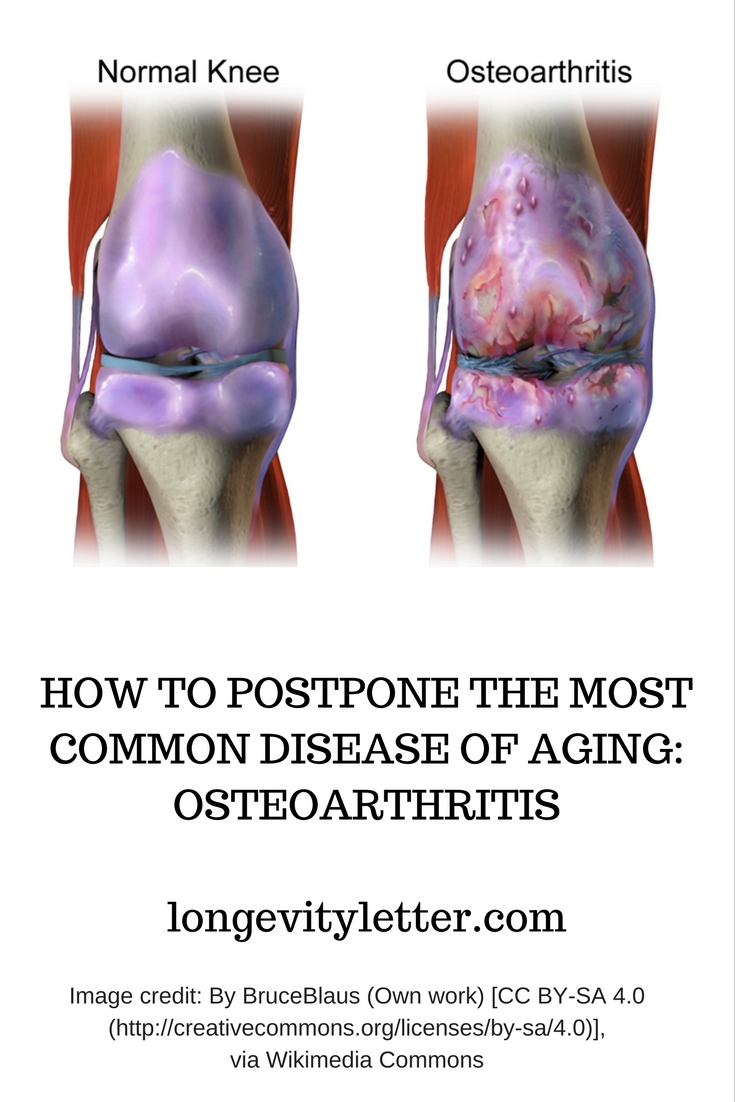
Image credit: BruceBlaus (Own work) [CC BY-SA 4.0 (http://creativecommons.org/licenses/by-sa/4.0)], via Wikimedia Commons
Anca Ioviţă is the author of Eat Less Live Longer: Your Practical Guide to Calorie Restriction with Optimal Nutrition ,The Aging Gap Between Species and What Is Your Legacy? 101Ways on Getting Started to Create and Build One available on Amazon and several other places. If you enjoyed this article, don’t forget to sign up to receive updates on longevity news and novel book projects!
Don’t miss out on the Pinterest board on calorie restriction with optimal nutrition where she pins new recipes every day.
https://www.pinterest.com/longevityletter/eat-less-live-longer/
Or the Comparative Gerontology Facebook Group where you can join the discussions on how species age at different speeds and what could be the mechanisms underlining these differences!
https://www.facebook.com/groups/683953735071847/

Eat less, live longer – your practical guide to calorie restriction with optimal nutrition
There is a fine line separating calorie restriction with optimal nutrition from starvation. Don’t cross it. Read this book instead.


During my third year of medical school I stumbled upon an online article about calorie restriction with optimal nutrition. I read about an apparently simple diet intervention that prolonged the average and maximum lifespan of laboratory animals such as yeast, fruit flies, worms and mice. At that time, I wasn’t aware that such experiments were already done on non-human primates too. Honestly, I dismissed it as a curiosity, an intervention that could have some effect in simple organisms such as fruit flies, but something which would never work in complex beings like us. It just seemed too good to be true.
Time passed and proved me wrong. Given an early childhood fascination with the limits of life extension, I studied engineering and medicine in an attempt to radically prolong human lifespan. After a short stint of research in neural prosthetics in a German lab, I realized implanting artificial devices into the human body is not a long-term solution. I returned home where I started the medical residency in geriatrics, the branch of medicine specialized in age-associated diseases.
A funny thing happened then. Reading about theories of aging is one thing. Daily caring for people 3-4 times your age is a completely different thing and I started to connect the dots. I noticed some people aged like wine and others aged like vinegar. According to their skinny frames and detailed lifetime stories, it looked like calorie intake had something to do with it. That’s how I got started in typing the first words for this book.


An interesting and potentially useful article but not clear what is it that can be hacked. GDF5 rs143383 SNP was found to be associated with human OA and degenerative disk disease. Would “hacking” this SNP prevent OA in carriers?
Thanks for your comment!
While ‘aging can be hacked’ has become the motto of this blog post, I mostly refer to hacking aging by using BIg Data to compare species ranging from those with almost instant aging to those who do not age and finally applying this knowledge into gradually aging humans. But not all blog posts refer to this hacking approach and this one certainly isn’t.
I didn’t know about this specific gene variant causing osteoarthritis and I doubt correcting it could prevent OA. I say this because several genes modulate OA and because the genetic expression itself leads to the phenotype of aging. We mostly have the same DNA from cradle to grave – except for mutations in specific tissues – and yet we look and behave differently from decade to decade. I expect genetic editing in adults to lead to more useful clinical applications compared to genetic engineering in embryos.
Not everyone get OA at the same chronological age. Those who carry the GDF5 mutation are more likely to get it. Whether correcting the mutation or its consequences would reduce the OA risk in carriers is a question that could be answered through research. If the correction works it could also be a good example – a proof of principle, if you will – of real biohacking!
I have a health blog that, while not as pretty, or as authoritative as yours, might offer a bit more information on avoiding arthritis. I hope you don’t mind my cross-posting the arthritis post from my health blog here:
http://amateur-attempt-at-preventive-health.blogspot.com/2013/12/arthritis-prevention-and-treatment.html
In that post, I cite references indicating that running, when done properly, does not promote, but actually prevents, arthritis. Numerous other preventive measures are cited, such as a carefully-chosen plant-based diet and a robust circadian oscillation.
Thank you for your comment!
I checked the references from your blog post and those referred to symptomatic (knee) osteoarthritis not being influenced by running. Most jogging is done on asphalt and I don’t know how well do professional running shoes cushion feet from micro-injuries when running. But take a look at table 1 in this study where several sports are compared according to the level of joint impact and torsional loading:
http://www.jospt.org/doi/pdf/10.2519/jospt.2003.33.10.578
I thought it is interesting to compare these sports – unfortunately for the topic here, there was no differentiation between casual jogging and competitive running, only the latter being mentioned.
Interesting and very informative article.
@Anca Ioviţă – Good mention in your comment above regarding jogging on asphalt. Running shoes help a bit however running barefoot on the sand is what works best for me. The only problem is that you can only do it the warm season.
Off-topic – Recently, I turned vegan and wrote this article on my blog. I would be grateful if you can share your opinion on this topic.
Your blog post, George Christea-Matei, does not mention what time of day this guy eats. My single meal starts 8-8:30 and continues until I finish, maybe 1:30-2pm. The resulting circadian strengthening benefits my quality of sleep. If I could compress this into a hour, I would, but eating as much fiber as I do (on a carefully-chosen vegan diet), I cannot imagine downing it all in one hour. I would also like to point out that exercise helps regulate blood sugar so that any such issues that might interfere with a daily 18-20-hour fast are not a problem.
Thank you for your comment!
I took a look over that article and I don’t understand one thing: what does lifting weights and eating vegan in one unverified case has to do with slowing down aging? There are a lot of vegan athletes and I don’t find anything strange about it: you can get your proteins if you mix-and-match plant sources. But this doesn’t mean I condone or recommend such a restricted regimen. Variety is the common denominator in what I recommend nutrition-wise and there is limited variety on a vegan diet.
Hello Otto Hunt,
Sorry for not not providing full details regarding Amen-Ra’s diet, I only wrote a resume just to intrigue people to watch the video. He eats his meal after his weights workout, usually around 20:00. He only consumes high density foods such as nuts, roots, beans and grains and the only type of fruits he consumes are dried fruits for desert. He avoids eating fresh fruits because they have a high water content and take up space. I am looking for as many opinions as I can get regarding this topic because there are a lot of people saying that it is impossible to look as good as he does with only one meal a day.
I am not convince that OA is among the earliest signs of aging in most people. What about signs of aging like graying hair, wrinkles, increasing blood pressure and weight gain? True, they may be more benign than OA (also elevated BP certainly is not) many people would be elated if you managed to bio-hack them.
Good question. In the beginning of my medical residency I was dumbfounded by incidental findings of OA in middle-aged people. I started reading the geriatrics and gerontological literature and went through my courses. It seems like joints do not have their own blood supply and as we get dehydrated with age, they are the first ones to suffer.
I wouldn’t include BP increase among the early signs of aging because age-related BP sets in after arteries becoming stiffer. True geriatric hypertension is mainly systolic, unlike the common hypertension form debuting during the middle age.
I give you credit for mentioning graying hair and wrinkles, I don’t really pay attention to this stuff but I should. It impacts lives by encouraging ageism, hence why many people try to hide them.
I wonder if anyone has tried to edit GDF5 (or another associated gene) using CRISPR? This should not be too difficult.
One frequent problem with aging is a semantic one when “time” and “aging” are used interchangeably. Time is not equivalent to aging. Aging is not equivalent to time. The time interval between 30 and 40 is the same as the time interval between 50 and 60, the biology, however, is very different. Not very many women become menopausal between 30 and 40 but most may become menopausal between 50 and 60. This is because time is linear but aging is not – it accelerates. Therefore, aging cannot be equated to time only. In a nutshell, time does not kill – aging does.