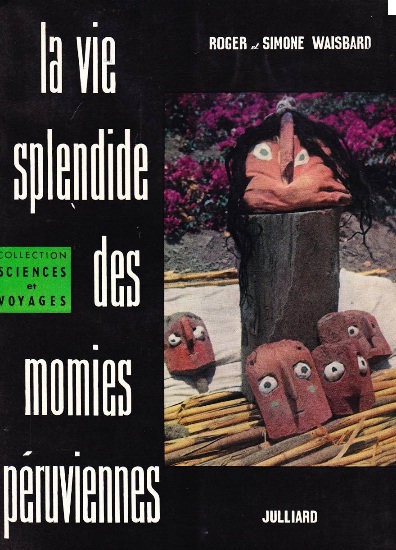
Perusing the bookshelves of my local public library, I stepped upon an old non-fiction book originally published in 1960 on one of my favorite subjects: Peruvian mummies.
A little bit too descriptive for my tastes regarding the history of the pre-Incan Peruvian populations and their mythology, I expected lots more referenced details on the mummification techniques themselves. To my surprise, I found only one of the fifteen chapters describing this aspect.
These mummies carried with them “luggage for the afterworld” – men carried the quena, which is a typical whistle made of reed or llama bones. Female mummies were found carrying spinning and weaving tools, as well as jewelry. Children were starting their afterlife together with their wooden dolls. Some Peruvian fardos contained mummified animals to accompany the human being “sleeping” there. The pacae beans were oftenly found in these sarcophagi, together with coca leaves.
One interesting theory was that the trephinations found in these skulls might have been caused by the embalming process itself, where the brain was either taken out of the skull or preserving aromatic oils were introduced through them.
The book was written in three parts, tracing the populations’ history before the Incan civilization, the life of the people that were once animating these mummies and the specific cults and mythology of this population.
The chapter depicting the unveiling of a 100 kg Peruvian fardo in a public setting was very thrilling – lots of white cotton layers interspaced by sand ones brightened up the imagination that a royal mummy might be hidden inside it. Unveiling it step by step, the fardo turned up to contain only a pulled up leg – probably from a religious sacrifice.
(A fardo is the typical Peruvian fabric “sarcophagus” which contains one or several related mummies in a fetus position; sometimes false cotton-stuffed heads with wooden masks are attached to them. The first appendix of the book contained a profile section drawing through a typical Peruvian fardo which explains their structure and contents very well.)
Although not a good reference regarding my specific interest on the subject, the slow rhythm of this old book that smelled of history itself is what made me finish it – if I were to read it on my ebook reader, I might have never finished it.
The book can be found at a library near you or on Amazon and other smaller French bookstores.

