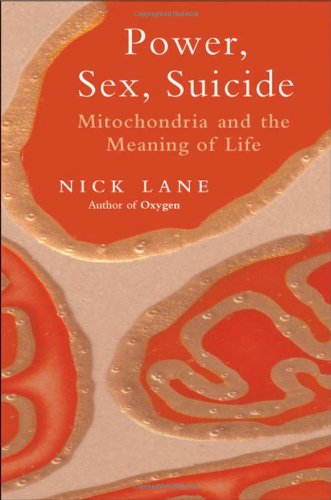
 Mitochondria are a wonderful present from your mother – these tiny organelles are inherited from the ova only, carrying their own DNA and providing you with the energy it takes to breathe, to keep your internal environment constant and to read this blog post at the same time!
Authored by the British biochemist Nick Lane, the title of the book brilliantly captures what is so special about them.
The author starts by introducing the bacterial origin theory of the mitochondria, followed by a detailed explanation of the proton pumps inhabiting their membranes – the mechanism behind their energetic efficiency.
This part of the book provided a good argument on why is the bacterial DNA so small – since bacteria were always pressured to get rid of the genes they do not need on the short-term – while our eukaryotic cells contain not only all the genes we need to function, but also “junk” DNA: the explanation is that a cell that contains energy powerhouse organelles can afford to increase in complexity – and with it, the whole organism as well. No wonder bacteria are still unicellular organisms.
The bacteria’s only chance of surviving was to replicate – fast! They didn’t have the “tools” for complexity – they could never afford to wait 18 years until their offspring matured (like our parents did).
The genes necessary for a mitochondria to function are spread both in the nuclear DNA as well as in their own DNA, so each of our cells – with the exception of red blood cells which lack a nucleus – are literally a symbiosis between these two DNAs. Which brings us to the next question: how do they cooperate and avoid competition? Or do they actually avoid competition?
This is where the second word from the title takes in: sex – an union of two genders. Why are there two genders? According to this book, there are even species with several genders! What makes them apart? Before reading this book, I never realized that the two genomes would be in competition, unless one of them is replicated by one gender only: the female gender; the mitochondria from the spermatozoid nourish the cell until it reaches its final destination, but they are eliminated together with the tail and the neck – only the spermatozoid’s head enters the ovum. No wonder the human genome was mapped using mitochondrial DNA.
Since I never thought about the implications of two genomes inhabiting one organism, some things I learnt in medical school never made sense:
-why would a female fetus loses most of its ova at birth
-why would about a third of all conceived fetuses be spontaneously aborted
No wonder: it takes lost of trials to produce a compatible mix of the two genomes, otherwise the primordial cell – and together with it the rest of the further organism’s cells – are going to die, thanks to energy deficiency!
I am at an age where I see the effects of aging on my parents – this comes after a lifetime question of why do we age and decay, when this phenomenon is so against the biological impetus to grow and repair our tissues?
Yet this is one of the few books that shed a light on this – not on the how, but on the why – and it again brought together several of my medical experiences into an EXPLANATION.
The two genomes of the primordial cell are compatible for a healthy organism to survive in a harsh world, but this equilibrium is so fragile! Both genomes suffer mutations over the course of a lifetime – and when this equilibrium is damaged, the cell suffers and commits apoptosis – it literally kills itself with free radicals – and who is in charge of this? The mighty mitochondria! Once several cells do this, you can start to see the clinical effects of aging.
Bacteria do not have two genomes to balance – they do not have our complexity, but they also never develop wrinkles!
And yet how come children are born young no matter the age of their parents? The mitochondria need a new nuclear copy – from the father – and by trial-and-error, a sound offspring will be produced. It is not clearly understood how and if mitochondria existing in one ovum compete with each other or whether there are different mitochondrial genome versions in different tissues inhabiting the same organism.
After so many gerontology books focused on the same free radicals theory, this book was a breath of fresh air. It contained just the right mix between being entertaining and really being informative.
The book can be found in several libraries worldwide or for sale on the author’s website.
Happy reading!
