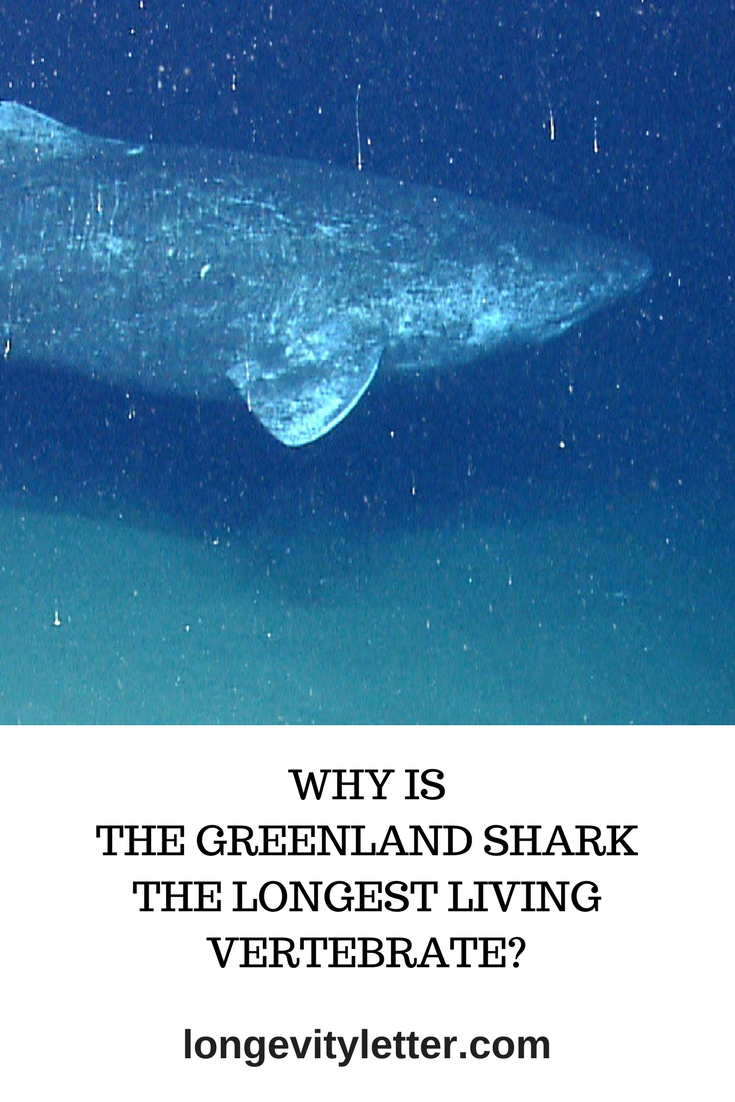
When I wrote ‘The aging gap between species’, the longest living vertebrate was the bowhead whale at 211 years old. The latter still holds the record for the longest living mammal, but these days the vertebrate record is held by the Greenland shark at 392 years.
Determining age in bony fish is done by counting calcification lines in their inner ear bones (otoliths), vertebrae or scales, but this is not possible in cartilaginous fish like sharks. Another method was used to determine the Greenland shark’s age: radioactive dating of the eye lens.
I was curious whether this shark could share any molecular tricks for its extreme lifespan, but research on it is quite scarce. Its size and extreme environment are understandable deterrents from attracting more researchers to study it. I haven’t been able to find any DNA sequencing data for Somniosus microcephalus, as this species is known for. Yet there is some data regarding its habitat and physiological blueprint which could account for its extreme lifespan.
First of all, the Greenland shark spends its days in cold, deep waters. While living in cold environments doesn’t have much influence over human lifespan, lowering the surrounding temperature increases lifespan in many ectothermic species. The deeper the water level, the lower its oxygen content. This is slightly mitigated by the increased solubility of oxygen at lower temperatures, making freezing waters more oxygenated compared to temperate ones. Living close to the bottom of the sea means a decreased need to adapt to environmental temperature variations since those places are stable and this ease of maintaining thermal homeostasis is associated with extreme longevity in many other groups of species like corals and sponges. Some weeks ago I read an interesting paper citing a link between living at depth and extended lifespans – although there was no mention of this shark, the same mechanisms could influence its lifespan too.
A second reason for which the Greenland shark evolved such a long lifespan is its lack of predators, at least according to what is known until today. This could be explained by its sheer size, extreme environment as well as the accumulated toxins necessary for surviving in cold and deep waters.
The shark’s meat is toxic when fresh, but can be consumed after being fermented for months. Currently, you can find it in stores around Iceland. I never tasted it and given its strong ammonia smell, not sure I’m even willing to do that. The accumulation of toxins is favored by its long lifespan. Its tissues are imbued with urea and trimethylamine N-oxide, both being nitrogenous waste products. These substances are osmoprotectants. They also prevent ice crystal formation and increase the shark’s buoyancy.
Other two factors that keep predators at bay are the shark’s size and the lower density of life forms able to survive freezing, deep waters. The largest Greenland shark known until now measured 502 cm in length and because such a big size increases the odds of survival, it pays to delay reproduction 150 years on average to favor somatic growth first.
The third reason for which this shark lives for a couple of centuries is its slow growth, estimated at 0.5-1 cm/year. It is unknown whether the Greenland shark grows continuously throughout its life or whether growth is stunted at adulthood. In line with its slow growth, sexual maturity is reached at 156+-22 years old on average. While the latter may be a good thing for its longevity, it also makes this species vulnerable to climate change since it takes so long to replenish its populations. Its slow growth and metabolism may be favored by its environment, but these may also be caused by its genetic blueprint. The Greenland shark is the slowest swimmer for its size and yet it manages to hunt faster swimming seals, probably by surprising them while sleeping.
All sleeper sharks – out of which the Greenland shark is but one species – are known for their slow swimming and low activity levels. While the Greenland shark made recent headlines for its longevity, it is possible that other sleeper sharks may lead long lives as well. They could also host molecular tricks not found in the Greenland shark. A comparative study among this group of species may shed some light in this regard, but who is willing to swim with the sharks and go get some samples?
References
Nielsen, J., Hedeholm, R. B., Heinemeier, J., Bushnell, P. G., Christiansen, J. S., Olsen, J., … & Steffensen, J. F. (2016). Eye lens radiocarbon reveals centuries of longevity in the Greenland shark (Somniosus microcephalus). Science, 353(6300), 702-704.
Costantini, D., Smith, S., Killen, S. S., Nielsen, J., & Steffensen, J. F. (2017). The Greenland shark: A new challenge for the oxidative stress theory of ageing?. Comparative Biochemistry and Physiology Part A: Molecular & Integrative Physiology, 203, 227-232.
Anthoni, U., Christophersen, C., Gram, L., Nielsen, N. H., & Nielsen, P. (1991). Poisonings from flesh of the Greenland shark Somniosus microcephalus may be due to trimethylamine. Toxicon, 29(10), 1205-1212.
Russo, R., Giordano, D., Paredi, G., Marchesani, F., Milazzo, L., Altomonte, G., … & Viappiani, C. (2017). The Greenland shark Somniosus microcephalus—Hemoglobins and ligand-binding properties. PloS one, 12(10), e0186181.
Watanabe, Y. Y., Lydersen, C., Fisk, A. T., & Kovacs, K. M. (2012). The slowest fish: swim speed and tail-beat frequency of Greenland sharks. Journal of Experimental Marine Biology and Ecology, 426, 5-11.
Skomal, G. B., & Benz, G. W. (2004). Ultrasonic tracking of Greenland sharks, Somniosus microcephalus, under Arctic ice. Marine Biology, 145(3), 489-498.
Strid, A., Jörundsdóttir, H., Päpke, O., Svavarsson, J., & Bergman, Å. (2007). Dioxins and PCBs in Greenland shark (Somniosus microcephalus) from the north-east Atlantic. Marine pollution bulletin, 54(9), 1514-1522.
Knoll, G. (2014). A giant in a changing ocean: unveiling the mysteries of the Greenland shark (Somniosus microcephalus).
Montero-Serra, I., Linares, C., Doak, D. F., Ledoux, J. B., & Garrabou, J. (2018). Strong linkages between depth, longevity and demographic stability across marine sessile species. Proc. R. Soc. B, 285(1873), 20172688.
Anca Ioviţă is the author of Eat Less Live Longer: Your Practical Guide to Calorie Restriction with Optimal Nutrition ,The Aging Gap Between Species and What Is Your Legacy? 101Ways on Getting Started to Create and Build One available on Amazon and several other places. If you enjoyed this article, don’t forget to sign up to receive updates on longevity news and novel book projects!
Don’t miss out on the Pinterest board on calorie restriction with optimal nutrition where she pins new recipes every day.
https://www.pinterest.com/longevityletter/eat-less-live-longer/
Or the Comparative Gerontology Facebook Group where you can join the discussions on how species age at different speeds and what could be the mechanisms underlining these differences!
https://www.facebook.com/groups/683953735071847/


Hi, glad to see you writing another article, it means your health allows it to!
Wow, 400 years, I thought only some plants are capable of such “feats”. Good news, to show people that the potential for engineered longevity is nearly limitless.
Thank you, I recovered faster than I expected. Granted, writing with a newborn at home is no piece of cake 🙂
It’s not only plants that are able to live for centuries, but animals too. The potential for engineered longevity is there, but all these animals live in harsh environments and/or are simple in design and/or are ectothermic and aquatic, so translating their metabolic tricks to humans won’t be easy.
Hi Anca! Very intersting article.
Congrats on your newborn :).
I have question for you.
Do you think human can age slower if they consume less oxigen?
For a very long time I have experienced oxygen deficiency due to breathing problems. I’m 34 now but I look like 22.
And I’m not Asian )).
Thank you!
That is an interesting question. I know of no clinical study that would prove lifespan benefits in humans under hypoxia, quite the opposite actually. Negligibly senescent species and/or the neotenic ones evolved in environments with intermittent oxygen restriction. This is used by athletes to improve endurance though.